What Does a Private Investigator Do in Oregon?

Investigation, Evidence, and the Legal Process

A private investigator develops facts for people and organizations that need reliable information but do not possess the investigative resources of a law-enforcement agency.

In Oregon, that work may include interviewing witnesses, locating and reviewing records, reconstructing timelines, documenting scenes, examining digital evidence, testing disputed claims, and reporting what the available evidence does—and does not—establish.

The investigator’s role is not to replace the police, an attorney, or the court. It is to find, preserve, organize, and evaluate information so that a client or attorney can make better-informed decisions.
In Practical Terms

  • Identify and interview witnesses
  • Locate and compare records
  • Reconstruct events and timelines
  • Preserve and review digital evidence
  • Test inconsistencies and assumptions
  • Document findings and limitations

NTRLNK VIDEO

Private Investigators, Police Detectives, and the Role of the Court

This short presentation explains how investigators develop facts, how legal authority is obtained, and why police detectives, private investigators, attorneys, and courts perform different but connected roles.

General educational information. Laws and procedures vary by jurisdiction. This presentation is not legal advice.

THE SHORT ANSWER

A Private Investigator Turns Questions into an Evidentiary Record

Most investigations begin somewhere quiet: with a question. What happened? Who was involved? What can be proven? Where are the records? Who saw it? What does the timeline show? What evidence is missing?

A private investigator approaches those questions systematically. The work may be narrow—such as locating one witness or authenticating a particular record—or it may involve a larger body of interviews, documents, digital data, and competing explanations.

The objective is not to produce a predetermined answer. It is to develop a record that permits the client, counsel, an organization, or another decision-maker to understand the facts with greater confidence.

01 / DEFINE

Identify the Questions That Matter

Clarify the purpose of the assignment, the decisions the investigation must support, the available evidence, and any legal, operational, or time-sensitive constraints.

02 / DEVELOP

Find Sources of Reliable Information

Identify witnesses, records, communications, photographs, video, digital activity, physical locations, and other sources that may confirm, challenge, or add context to the existing account.

03 / TEST

Compare Evidence and Explanations

Evaluate reliability, corroborate important details, reconstruct chronology, identify inconsistencies, and consider whether the evidence supports reasonable alternative explanations.

04 / REPORT

Explain What Can Be Established

Present relevant facts in a usable form while distinguishing source information, analysis, limitations, unresolved questions, and recommended areas for additional investigation.

A CRITICAL DISTINCTION

Private Investigators Are Not Police Detectives

An Oregon private-investigator license authorizes a person to provide defined investigative services. It does not make the investigator a police officer, confer governmental authority, or create a general power to compel cooperation.

A private investigator cannot obtain a search warrant merely by virtue of being licensed, cannot require a person to answer questions, and cannot independently order a business or government agency to produce protected records.

Oregon law also prohibits conduct that creates the impression that a private investigator is connected with a government agency when no such connection exists. NTRLNK performs private investigative work and claims no governmental or law-enforcement authority.

See ORS 703.401–703.490.

VOLUNTARY COOPERATION

Many Investigations Begin by Asking

A witness answers the door. A business voluntarily provides an authorized record. A person agrees to explain what they observed. Police often seek voluntary cooperation before pursuing legal compulsion, and private investigators do the same.

The important distinction is that asking is not compelling. A private investigator must work through lawful access, consent, public information, client-authorized sources, and—when counsel is involved—the legal procedures available to the attorney and court.

  • Interviews depend upon voluntary participation unless lawful process applies.
  • Private records are not automatically available to an investigator.
  • Access to devices, accounts, locations, and data must be legally authorized.
  • Professional persistence does not justify deception about government authority.

STATE-SIDE PATHWAY

Facts Can Become Public Legal Authority

A police investigation may develop facts supporting probable cause or another legal standard. A prosecutor can evaluate those facts, and a judge may authorize a warrant or other compulsory process when the legal requirements are satisfied.

The police do not simply create judicial authority for themselves. Investigators develop facts; prosecutors make legal applications; courts decide whether the requested authority should issue.

PRIVATE-SIDE PATHWAY

Facts Can Inform Private Legal Action

A private investigator develops facts for an attorney, organization, insurer, or private client. Counsel may use the resulting information to guide subpoenas, discovery requests, depositions, expert review, motions, negotiations, or applications for court orders when those tools are legally available.

The powers are not identical, but the structural principle is similar: investigation develops facts; legal professionals evaluate the available procedure; the court resolves matters requiring judicial authority.

WHY THE ROLE MATTERS

A Private Investigator Does Not Need Police Power to Be Useful

The record that changes a timeline, the witness who was overlooked, the inconsistency that requires explanation, or the digital evidence that needs preservation may change how an attorney or client understands an entire matter.

Private investigation is valuable because legal and organizational decisions depend upon the quality of the underlying facts. Even when information must ultimately be obtained through counsel or court process, an investigator can identify what exists, why it matters, where it may be found, and how it relates to the rest of the evidence.

Evidence May Change

  • How events are sequenced
  • Which account is corroborated
  • Whether an inference is justified
  • What additional process is needed
  • How risk should be evaluated
  • Whether a conclusion remains supportable

COMMON ASSIGNMENTS

What a Private Investigator in Oregon Actually Does

Witness Interviews and Re-Interviews

Locating people with relevant knowledge; obtaining voluntary accounts; clarifying ambiguous statements; identifying additional witnesses; and documenting what was said in a form appropriate to the assignment.

Records, Research, and Timeline Development

Finding and comparing reports, public records, communications, photographs, video, business information, and client-authorized materials to reconstruct events and identify gaps or conflicts.

Scene, Location, and Background Inquiries

Documenting relevant conditions; identifying cameras, businesses, records, or potential witnesses in an area; examining representations and affiliations; and developing context that may not appear in the original file.

Fraud, Misconduct, and Due Diligence

Investigating disputed conduct, misrepresentation, misuse of resources, financial irregularities, conflicts of interest, policy violations, and higher-stakes questions that require more than routine screening.

A PARTICULAR NTRLNK STRENGTH

Digital Evidence and Independent Forensic Review

Modern investigations frequently involve mobile devices, messaging, email, photographs, video, cloud activity, location information, metadata, or records produced by digital systems. The existence of a technical report does not necessarily mean that every relevant question has been answered.

NTRLNK reviews forensic examinations, device-extraction reports, communications, video, metadata, timelines, evidence-handling procedures, and technical conclusions. The purpose is to determine whether the stated interpretation is supported by the underlying evidence and whether limitations, missing context, attribution problems, or reasonable alternative explanations have been overlooked.

  • Completeness and reliability of collected evidence
  • Support for the technical conclusions presented
  • Attribution of activity to a person, account, or device
  • Timestamp, time-zone, sequence, and chronology issues
  • Extraction limitations, missing records, and incomplete datasets
  • Conflicts between reports, testimony, and underlying data
  • Evidence preservation, handling, and analytical process
  • Unsupported, overstated, or overly certain interpretations

Independent review may support investigative strategy, additional evidence development, cross-examination preparation, rebuttal analysis, expert consultation, or a better-informed decision about what the evidence actually supports.

ATTORNEYS AND CONTESTED MATTERS

Investigation in Support of Legal Strategy

Attorneys may engage a private investigator when a matter requires independent fact development beyond the existing police report, discovery production, claim file, or opposing account.

Assignments may include witness interviews, discovery review, chronology reconstruction, records development, scene inquiries, background research, digital-evidence analysis, identification of missing evidence, or evaluation of an opposing investigative or forensic conclusion.

When counsel directs the work, the investigator should understand the legal purpose of the assignment, coordinate findings with counsel, and handle sensitive information with appropriate attention to confidentiality and the anticipated use of the work product.

ORGANIZATIONS, INSURERS, AND PRIVATE CLIENTS

Independent Facts for Consequential Decisions

An organization, insurer, or private client may need an independent investigator when allegations are sensitive, accounts conflict, existing information is incomplete, or the consequences of an incorrect conclusion are substantial.

A well-defined assignment can help determine what is known, what remains uncertain, which sources are reliable, and what additional steps are proportionate. Depending upon the matter, an attorney may need to be involved before investigative work begins or as legal issues develop.

NTRLNK does not provide legal advice. When a question concerns legal rights, litigation strategy, criminal exposure, or compulsory process, clients should obtain advice from qualified counsel.

OREGON PRIVATE INVESTIGATOR FAQ

Are Private Investigators Licensed in Oregon?

Oregon generally requires a person who engages in the business of investigation or accepts investigative employment of the kind defined by statute to hold the appropriate license. The Oregon Department of Public Safety Standards and Training administers the state’s private-investigator licensing program.

Members of the public can verify an investigator by name or DPSST-issued Private Investigator Identification Number through the state’s I.R.I.S. license-information system.

Can a Private Investigator Obtain Confidential Records?

A private-investigator license does not create unlimited access to confidential information. Records must be obtained through a lawful source, valid authorization, consent, public-record process, client access, or an appropriate legal procedure. The rules governing access depend upon the type of record and the purpose for which it is sought.

Can a Private Investigator Issue a Subpoena?

A private investigator does not independently exercise judicial authority. When a matter permits subpoenas, discovery, depositions, or court orders, those tools operate through the applicable legal process. An investigator may help identify the evidence or witness, explain its relevance, and support counsel in preparing for the information obtained.

How Should Someone Choose an Oregon Private Investigator?

Verify the investigator’s license, evaluate whether the investigator has experience relevant to the matter, and ask how scope, lawful methods, communication, costs, documentation, confidentiality, and reporting will be handled. The most useful investigator is not necessarily the one who promises the most; it is the one whose approach is proportionate, lawful, methodical, and appropriate to the decision the work must support.

Information about Oregon’s licensing program is available from the DPSST Private Investigator Program.

WHY NTRLNK

Investigation and Forensic Analysis in One Practice

Direct Senior-Level Attention

Every engagement receives direct oversight from the investigator responsible for strategy, analysis, findings, and work product.

Traditional and Digital Evidence

Witness accounts, records, digital activity, chronology, and technical conclusions can be evaluated together rather than as disconnected pieces.

Clear, Evidence-Grounded Reporting

Findings distinguish what is established, what is inferred, what remains uncertain, and what additional investigation may be justified.

BASED IN SALEM · SERVING OREGON

Oregon Investigative and Forensic Services

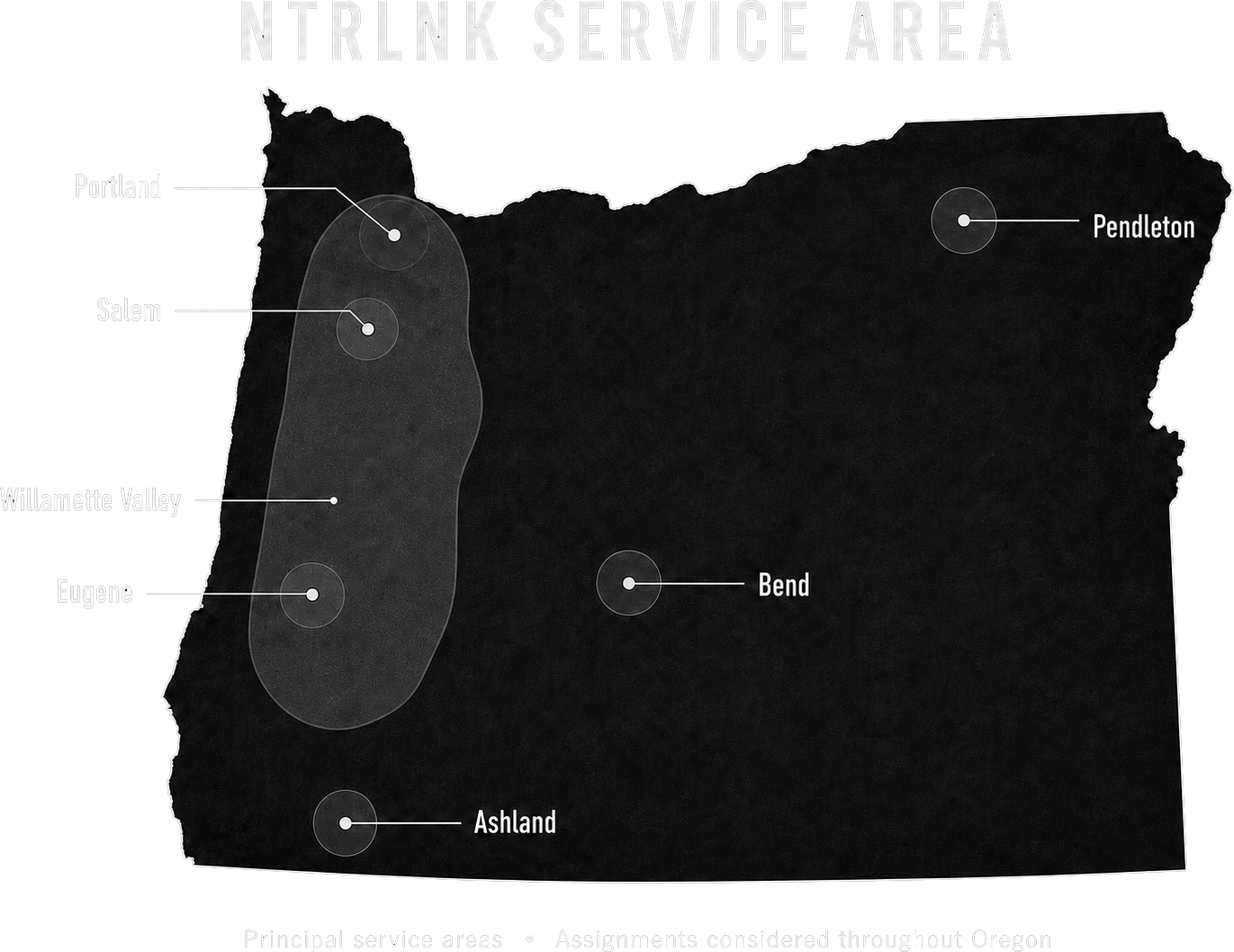
NTRLNK is a Salem-based private investigation and digital forensics firm serving attorneys, businesses, organizations, insurers, and private clients throughout Oregon. Principal service areas include Salem, Marion County, Polk County, the Willamette Valley, Portland, Eugene, Bend, Pendleton, and Ashland. NTRLNK also considers investigative, evidence-review, and digital-forensic assignments in other Oregon communities based on the needs of each matter.

For a fuller description of available services, visit Oregon Private Investigator & Forensic Services.

NTRLNK Oregon private investigator service areas including Salem, Portland, Eugene, Bend, Pendleton, and Ashland

Request an Initial Consultation

NTRLNK accepts inquiries involving digital evidence, litigation support, witness interviews, records development, internal misconduct, fraud, due diligence, insurance and liability matters, and other sensitive investigations throughout Oregon.

Contacting NTRLNK does not itself create an investigator-client relationship. Prospective clients should avoid sending highly sensitive evidence or confidential case materials until appropriate intake arrangements have been established.

Call or text (503) 931-8698 · info@ntrlnk.net